
Youngstown-Warren Tops National Rankings: What It Means for Businesses
Cotality just named Youngstown-Warren the hottest housing market in America. Area Development moved us from 234th to 23rd in two years. Here is what those numbers actually mean for the people who live and do business here.
I have lived in this region long enough to remember when national press about the Mahoning Valley was almost always written in the past tense. Steel that used to be made here. Plants that used to employ thousands. The story was always about what we lost.
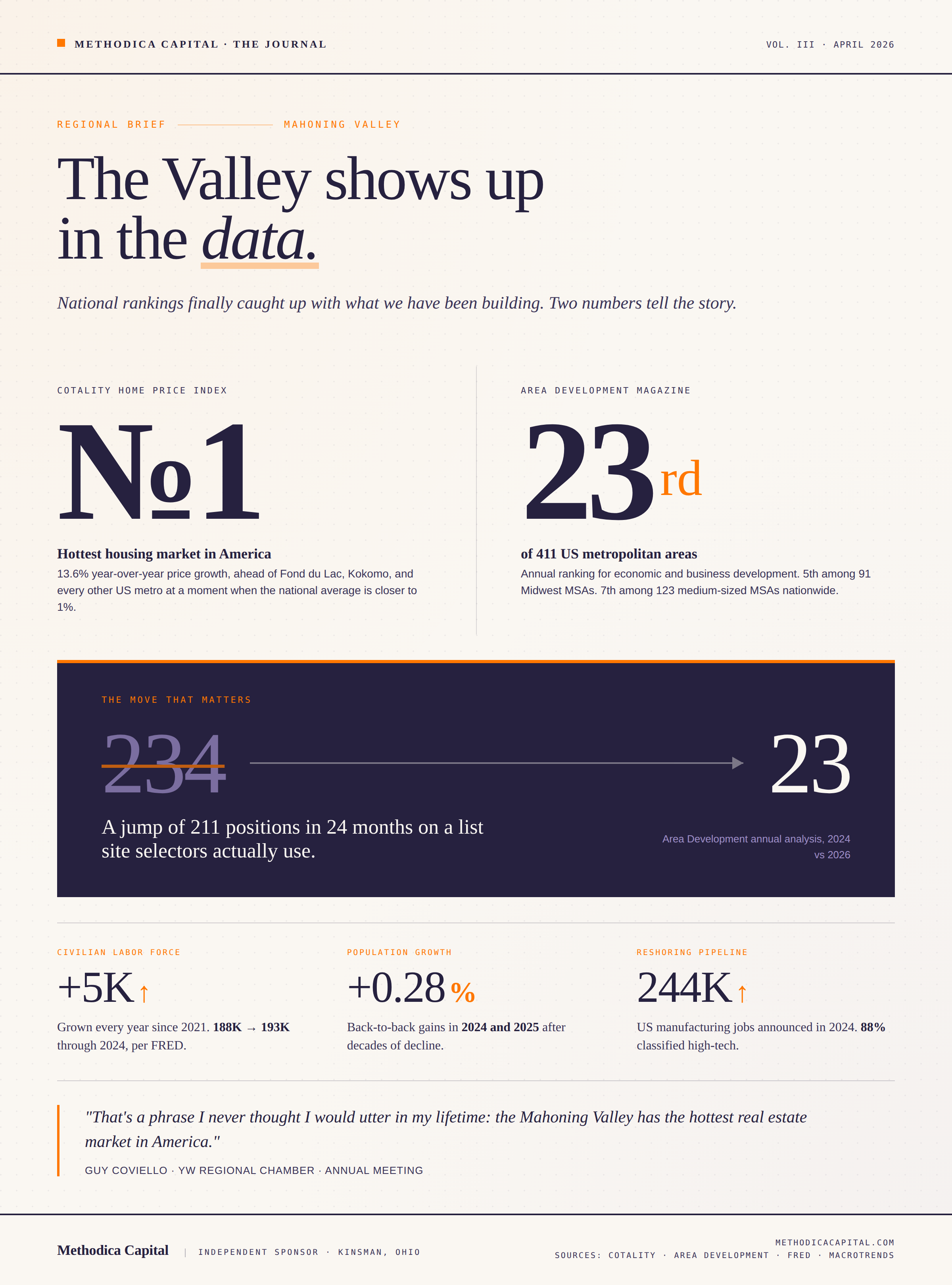
The story changed this month. At the Youngstown/Warren Regional Chamber's annual meeting, Guy Coviello put it in plain language. "That's a phrase I never thought I would utter in my lifetime: the Mahoning Valley has the hottest real estate market in America." He was referring to Cotality's latest Home Price Index, which placed Youngstown-Warren at the top of its national rankings with year-over-year price growth of 13.6 percent. That puts us ahead of Fond du Lac, Kokomo, Glens Falls, and every other metro in the country at a moment when the national average is closer to one percent.
That headline alone is worth reading twice. But it is not the most important number in the announcement.
The number I keep coming back to
Two years ago, the Youngstown-Warren market ranked 234th out of 411 metropolitan areas on Area Development magazine's annual analysis of economic and business development. This year we ranked 23rd. That is a move of 211 positions in 24 months. We also placed 5th among 91 Midwest MSAs and 7th among 123 medium-sized MSAs nationwide.
Area Development is read by the people who decide where companies build, expand, and relocate. Site selectors. Corporate real estate teams. Economic development professionals. A jump of that size on a list they take seriously is not a press release. It is a signal that the underlying economics of this region have changed.
The labor force data tells the same story in a slower register. The civilian labor force here has grown every year since 2021, climbing from 188,000 to 193,000. The Youngstown metro population grew 0.28 percent in both 2024 and 2025. Those are not large numbers in absolute terms. They are extraordinary numbers in context. This region had been losing population for most of my lifetime. Two consecutive years of growth, however modest, breaks a trend line that goes back decades.
What the data is actually registering
Cotality's chief economist, Selma Hepp, framed the broader picture in their report. National home price growth has fallen to a 14-year low. The hot pandemic markets in Florida and Texas have cooled, with several Sun Belt metros now leading the country in price declines. What is driving demand instead is what Hepp calls a renewed preference for "areas that offer both economic opportunity and relative affordability."
Read that phrase carefully. For 40 years the Mahoning Valley had affordability in abundance and not nearly enough of the first thing. What the Cotality data is registering is the opposite condition starting to take hold. Jobs are coming back. Wages are rising. Housing demand is following. Prices are responding to the demand.
The Cleveland Federal Reserve published a research brief in late 2025 that helps explain what is happening underneath the rankings. Their analysis looked at where reshoring manufacturers might find workers, and the Fourth District (which includes the Mahoning Valley) showed up well. The labor force here still has muscle memory of how a manufacturing economy works. The training infrastructure is still in place. The cost of living lets companies pay competitive wages without paying coastal real estate premiums.
That setup is not theoretical. The Reshoring Initiative tracked 244,000 manufacturing jobs announced in 2024 through reshoring and foreign direct investment, with 88 percent classified as high-tech or medium-high-tech. Locally, the Mahoning Valley Manufacturers Coalition now includes more than 70 member companies working together on workforce pipeline. The Youngstown Business Incubator continues to anchor a growing innovation ecosystem.
What this means if you own a business here
I run an deal by deal private equity firm focused on acquiring founder-led and family-owned businesses in this region. So I look at this data through a particular lens. Here is what I am taking from it.
The capital is starting to follow. When a region moves from 234th to 23rd on a list site selectors actually use, capital allocators notice. That includes the kind of capital that funds acquisitions of mid-sized manufacturers, distributors, and industrial services companies. For owners thinking about a transition in the next three to five years, the buyer pool looking at this region is larger and better capitalized than it has been in a generation.
Asset values are repricing. A 13.6 percent jump in residential prices is not the same as a 13.6 percent jump in business valuations. But the underlying drivers overlap. When housing tightens because more people want to live here, labor markets tighten too. Companies look more attractive on paper because their growth profile improves alongside the regional one. Owners who have not had their business valued in a few years may find the number is meaningfully different than they expect.
The window matters. Coviello's other line at the annual meeting is the one I keep thinking about. "We're not going to take a victory lap. We're going to build on it." He is right that this is a beginning, not a destination. But for individual business owners, the window of being an undervalued region with rising fundamentals does not stay open forever. The companies that get sold or recapitalized over the next few years will be priced inside that window. The ones that wait until the region is fully discovered will be priced differently.
Where this leaves us
National press about the Mahoning Valley used to be written in the past tense. The Cotality and Area Development rankings are the first time in a long time that the press is in the present tense. Jobs are growing. Population is growing. Housing is the hottest market in the country.
For owners who have spent their careers in the Valley, the numbers are an invitation to look at your business with fresh eyes. Whatever you thought it was worth two years ago is probably the wrong number. Whatever you thought the buyer pool looked like is probably the wrong picture. The region you have been operating in is not the same region today, and the trajectory it is on changes the math on a lot of decisions.
That is a good problem to have. We have not had it in 50 years.
Trevor Harnett is the founder and managing partner of Methodica Capital, a deal by deal private equity firm based in Kinsman, Ohio focused on acquiring founder-led and family-owned businesses in Northeast Ohio and Western Pennsylvania. If you own a business in the region and want to think through what these trends mean for you, please reach out.
